Know what is true about your cloud—and what to improve next.
ArchMate unifies automated architecture reviews, security and compliance assessments, FinOps intelligence, resource inventory, and AI-powered infrastructure exploration in one platform.
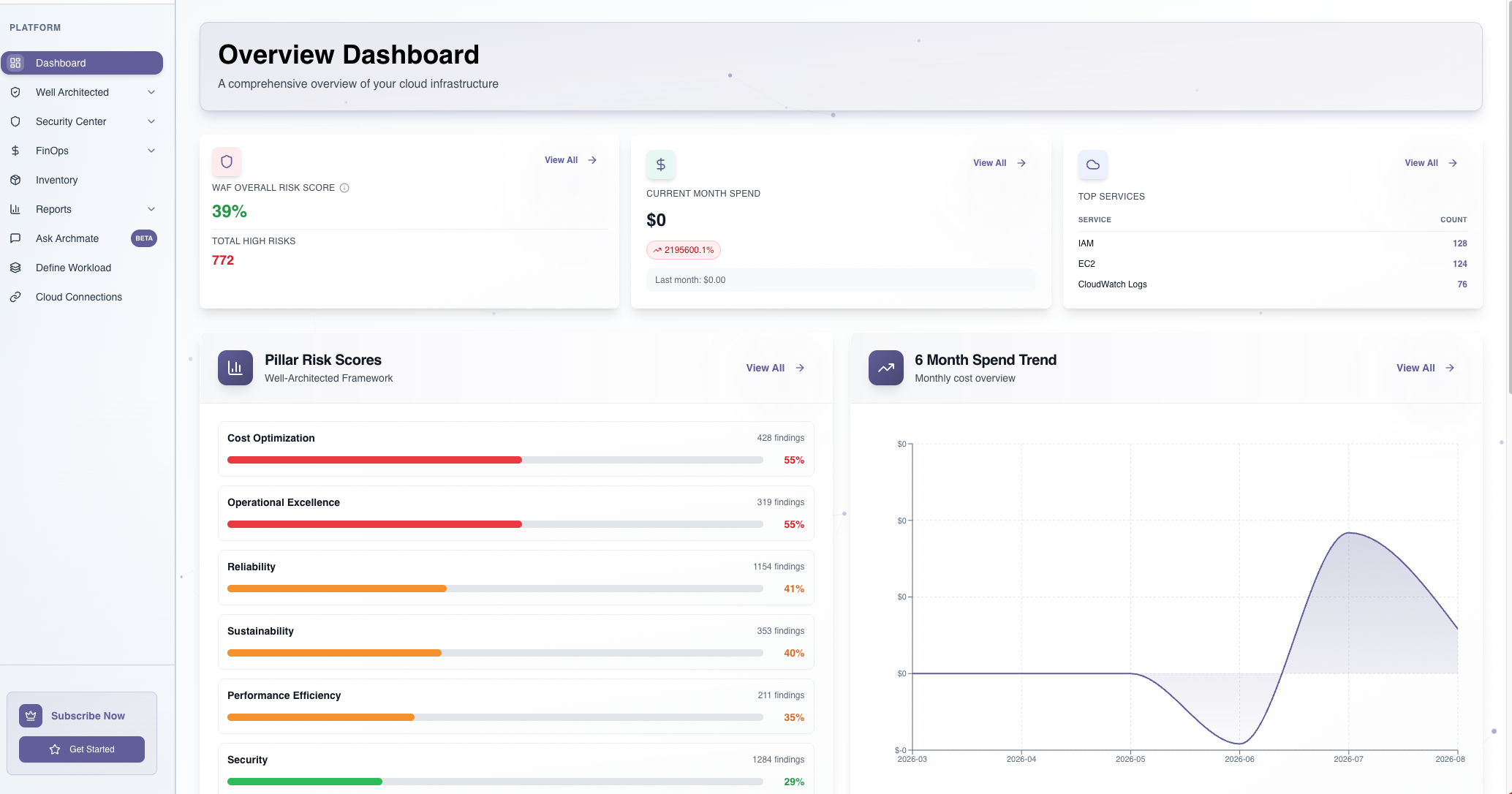
The overview brings architecture risk, current spend, inventory, pillar health, and trends together so teams can decide where to look first.
ArchMate
Overview dashboard
A common starting point for cloud, security, finance, and leadership conversations.
Four connected capabilities
From cloud evidence to a prioritized action.
Each capability is useful on its own. Their greater value comes from sharing the same context across architecture, security, cost, and resources.
01
Architecture assurance
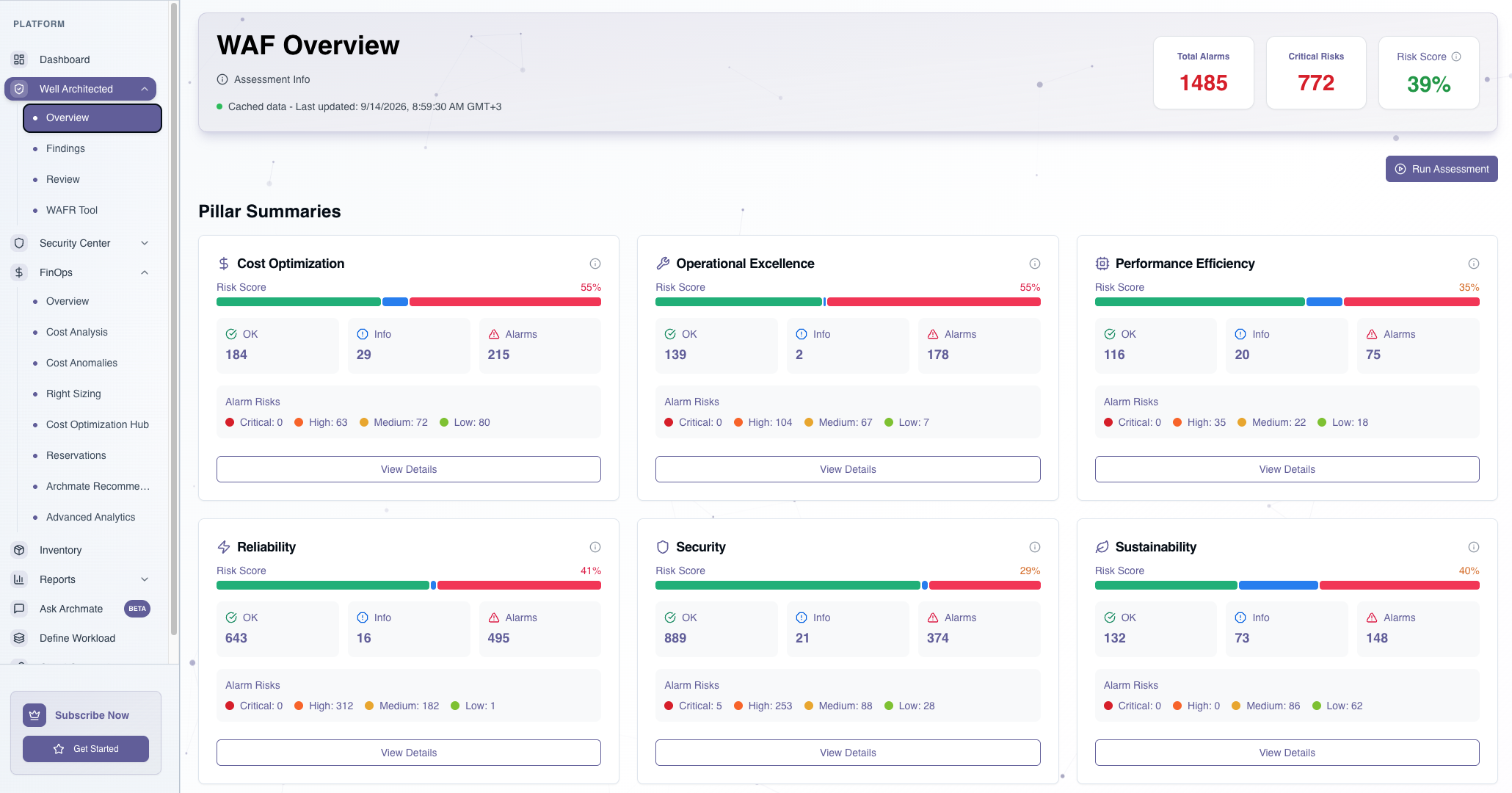
Automated Well-Architected reviews
Assess workloads against the six pillars of the AWS Well-Architected Framework and move from a high-level risk score to the findings that need attention.
Pillar-by-pillar risk visibility
Detailed findings and recommendations
Repeatable assessments and posture tracking
Automated Well-Architected reviews
02
Security & compliance
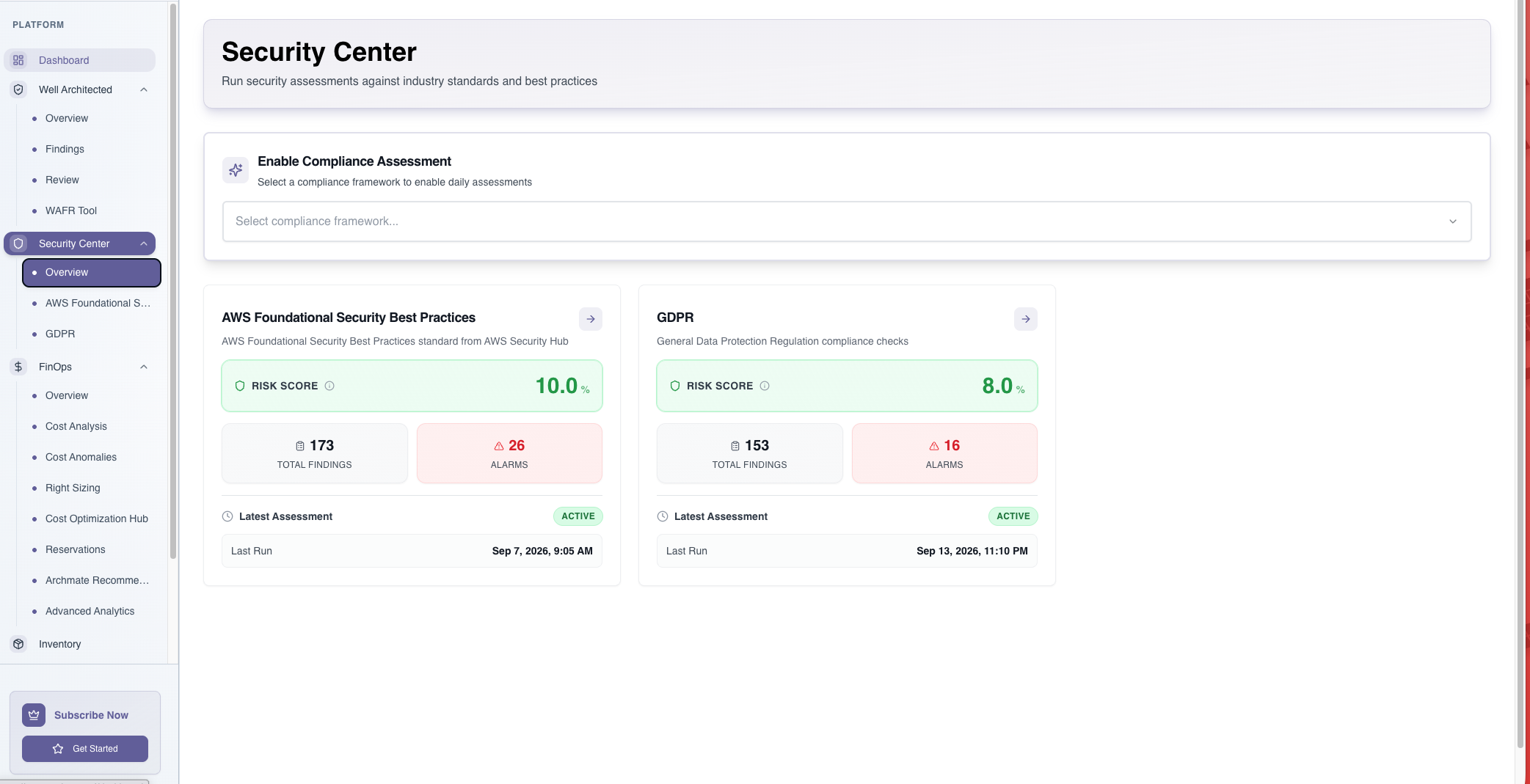
One Security Center for control visibility
Run security and compliance assessments, see risk by framework, and give engineering teams a clearer route from a control finding to remediation.
AWS security best-practice assessments
Compliance framework views
Finding, alarm, and assessment history
One Security Center for control visibility
03
FinOps intelligence
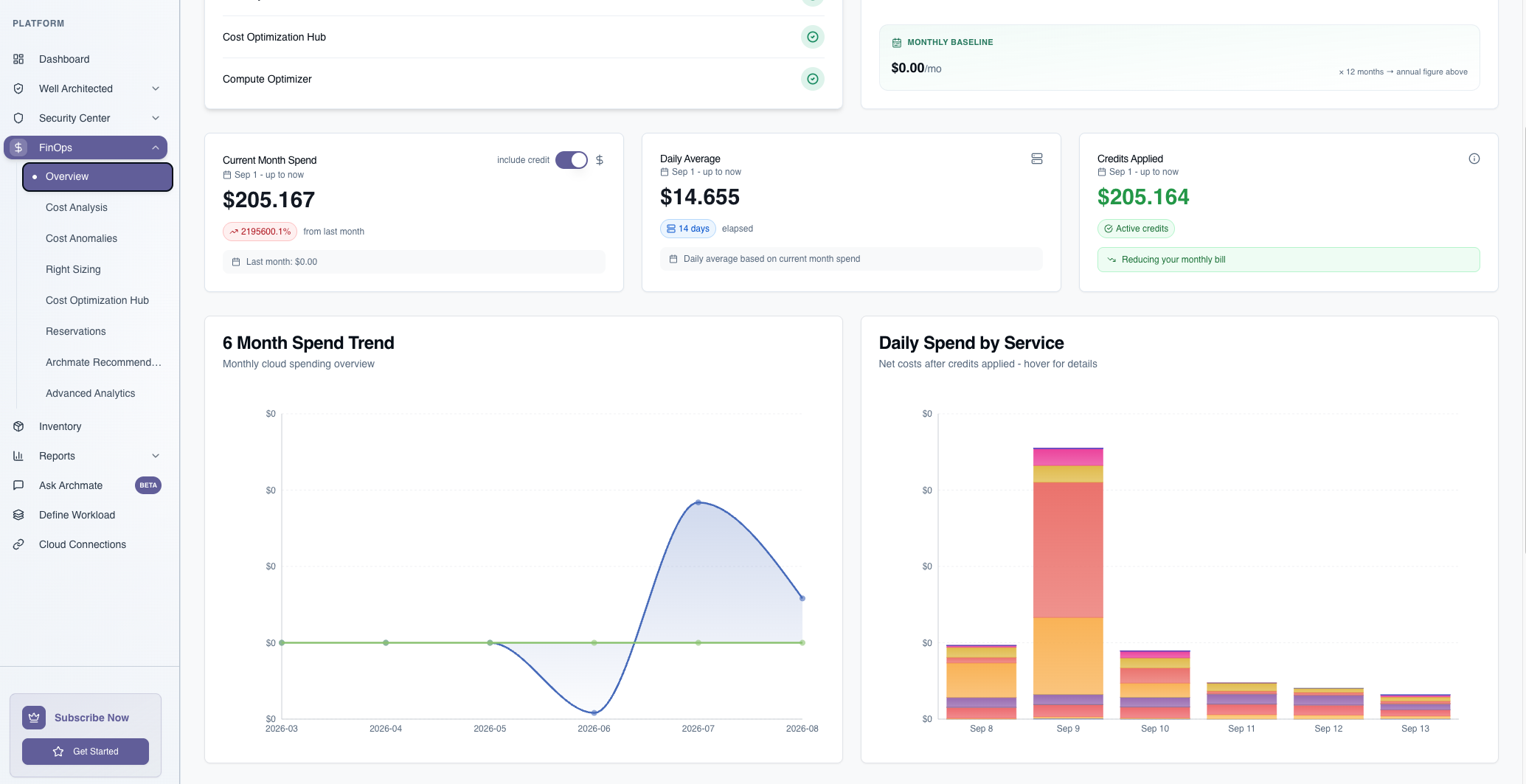
Understand spend and act on waste
Bring cost trends, service-level spend, anomalies, right-sizing, reservations, and optimization recommendations into the same operational view.
Daily and monthly spend analysis
Cost anomalies and right-sizing
Reservation and optimization guidance
Understand spend and act on waste
04
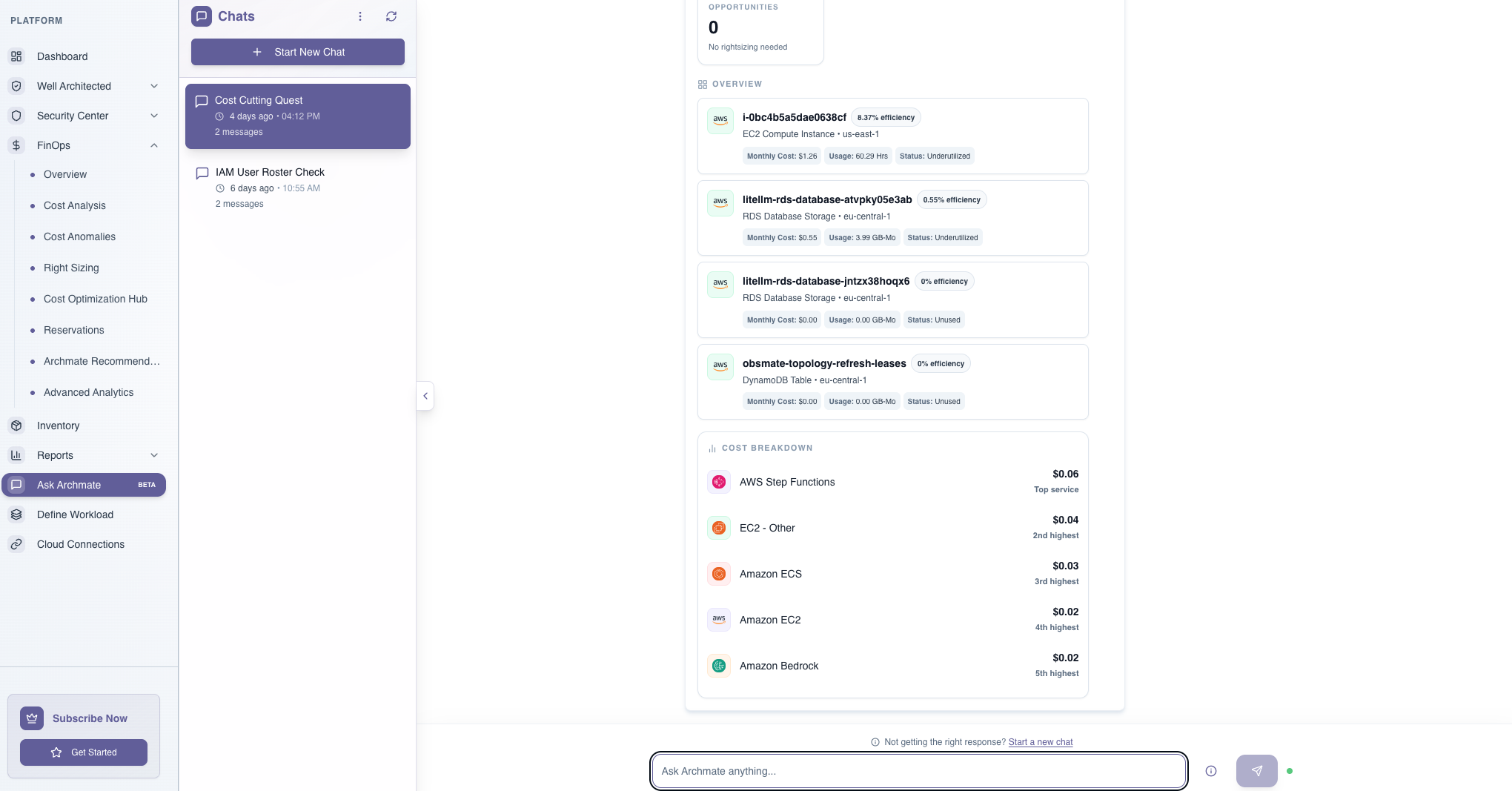
AI infrastructure chat
Ask your infrastructure a direct question
Use natural language to explore resources, costs, risk, and optimization opportunities without assembling the answer across multiple cloud consoles.
Context-aware infrastructure answers
Cost and resource investigation
Actionable explanations and recommendations
Ask your infrastructure a direct question
How ArchMate works
Connect. Assess. Prioritize. Improve.
ArchMate provides continuous evidence and a shared operating view. Your team stays in control of priorities and remediation.
01
Connect securely
Use role-based access to connect the accounts and regions included in your review scope.
02
Build context
Inventory resources and organize evidence across workloads, architecture, security, and cost.
03
Assess continuously
Run repeatable checks, surface findings, and track posture instead of relying on a one-time snapshot.
04
Act with confidence
Prioritize recommendations, assign ownership, and measure improvement across review cycles.
A practical comparison
ArchMate compared with a fragmented toolchain.
Cloud-native tools remain valuable. ArchMate adds a connected governance layer that makes their evidence easier to interpret, prioritize, and use across teams.
Area
With ArchMate
Fragmented or manual approach
Architecture reviews
Repeatable assessment and pillar-level posture in one workflow
Periodic workshops, documents, and evidence gathered by hand
Security & compliance
Framework views connected to cloud findings and assessment history
Findings and control mappings spread across tools and spreadsheets
FinOps
Spend, anomalies, right-sizing, reservations, and recommendations together
Billing views separated from architecture and ownership context
Investigation
Natural-language exploration across infrastructure, risk, and cost
Multiple consoles, queries, exports, and manual correlation
Improvement
A shared baseline and review history for engineering, security, and finance
Point-in-time reports with limited cross-team continuity
Frequently asked questions
Evaluate ArchMate against your environment.
The fastest way to understand fit is to start with your actual account structure, governance priorities, and assessment requirements.
ArchMate brings architecture assurance, cloud resource inventory, security and compliance assessment, FinOps analysis, reporting, and AI-assisted infrastructure exploration into one platform. Available depth depends on the connected cloud provider and enabled modules.
Does ArchMate replace an AWS Well-Architected review with an architect?
ArchMate automates evidence collection, checks, scoring, and repeatable analysis so teams can review more consistently and frequently. Expert judgment remains valuable for business context, tradeoffs, workload priorities, and remediation decisions; CloudVests can provide that support.
Which security and compliance frameworks are supported?
ArchMate supports a growing set of security and compliance frameworks, including AWS security best practices and widely used standards such as CIS, NIST, PCI DSS, GDPR, HIPAA, ISO 27001, SOC 2, and FedRAMP. Confirm the exact framework and cloud coverage required for your environment during evaluation.
Can ArchMate connect to multiple cloud accounts?
Yes. ArchMate is designed for multi-account and multi-region environments, including AWS Organizations. Connections use role-based access so the permissions and scope can be defined for the assessment and operational requirements.
How quickly can we see value?
The first useful output depends on account scope, permissions, and enabled modules. The recommended starting point is a seven-day value audit that establishes an initial architecture, security, and cost baseline for your environment.
Seven-day value audit
Start with your real cloud environment.
Establish an initial view of architecture, security, and cost—and identify the priorities worth acting on first.